
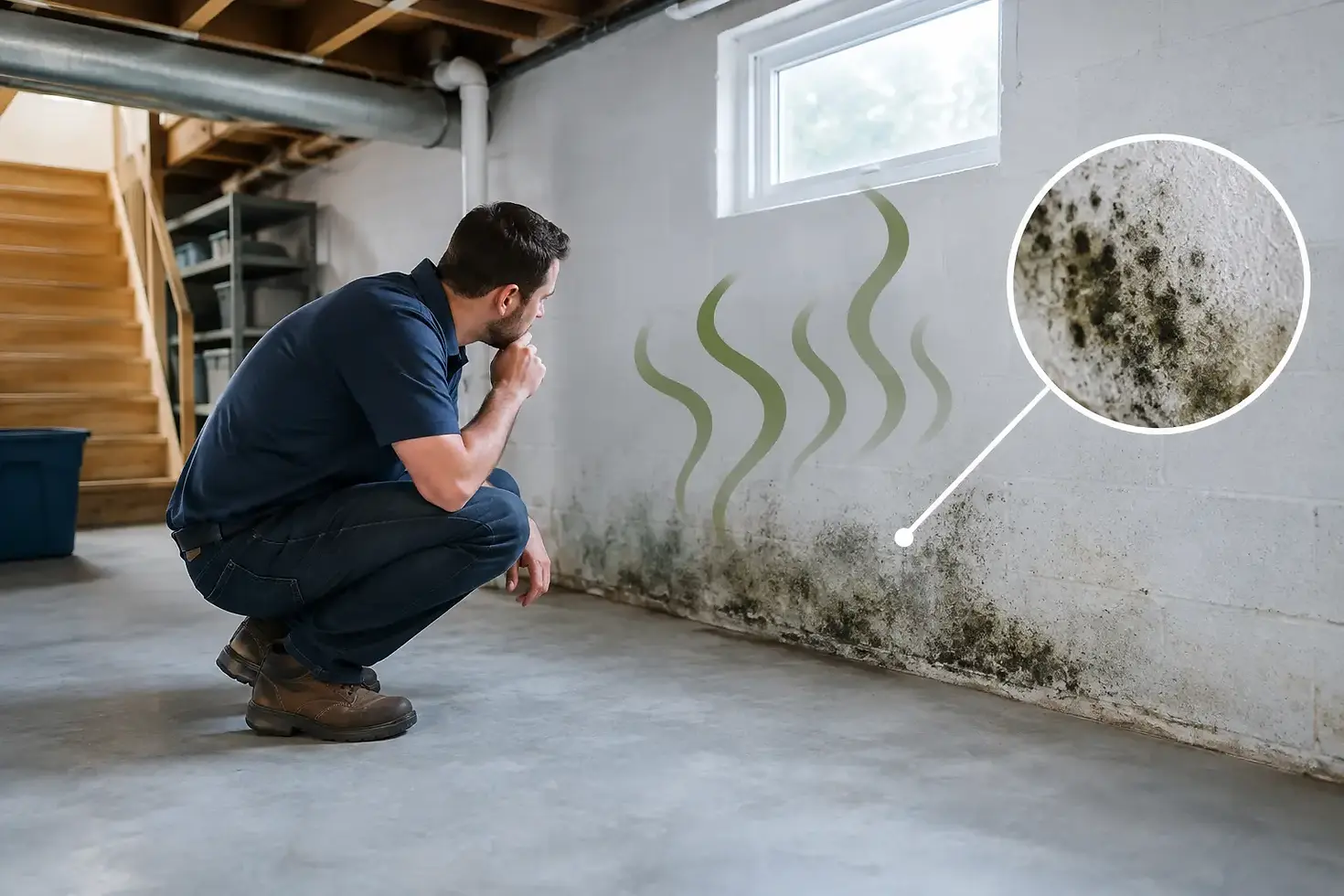
Why Does Your Basement Smell Musty? Find the Cause

A musty basement smell usually shows up before the damage becomes obvious. You may notice it when you open the door after a rainy Atlanta week, when the HVAC starts running, or when stored items begin to hold the odor. If you are asking, “why does basement smell musty,” the short answer is moisture. The right answer requires finding where that moisture is coming from and whether it has already affected building materials.
A dehumidifier or air freshener may make the room more tolerable for a while, but neither fixes a damp wall cavity, a drainage issue, or mold growth under flooring. For a basement you plan to finish, use regularly, or protect as part of a valuable home, the source matters more than the smell.
Why Does a Basement Smell Musty?
Basements are naturally more vulnerable to moisture than the rest of the home. They sit below grade, surrounded by soil that holds water after rain. Concrete can also allow water vapor to move through it, even when there is no visible leak. Add limited airflow, cooler surfaces, and Georgia humidity, and you have conditions where mildew and mold can grow.
The familiar musty odor comes from microbial volatile organic compounds. In plain terms, mold and mildew release gases as they grow on damp organic materials such as wood framing, drywall paper, carpet backing, insulation, cardboard, and dust. The odor does not automatically mean there is a major mold problem, but it is a signal worth taking seriously.
A basement can smell musty even when it looks clean and dry. Water may be entering behind finished walls, below laminate flooring, around a foundation crack, or through the joint where the wall meets the slab. That is why a surface-level cleaning often fails to solve the problem.
The Most Common Sources of Basement Moisture
Exterior drainage problems
Poor drainage is one of the most common causes of a damp basement. Gutters that overflow, downspouts that release water beside the foundation, and landscaping that slopes toward the house can keep soil saturated around basement walls. During a hard rain, that water creates pressure against the foundation and finds its way through cracks, joints, or porous materials.
Start outside. Gutters should be clean and properly pitched, and downspouts should carry water well away from the foundation. The ground should slope away from the house rather than directing runoff back toward it. A homeowner can address some basic maintenance items, but recurring water near the foundation may call for a more complete drainage strategy.
Foundation cracks and wall leaks
Not every foundation crack leaks, and not every leak is a structural concern. Hairline cracks can be common as concrete cures and a home settles. Still, a crack that is wet, stained, widening, or repeatedly associated with an odor deserves attention.
Water can also enter through pipe penetrations, basement windows, window wells, and the cold joint between the foundation wall and slab. The correct repair depends on the source. Sealing a visible crack from the interior may help in a limited situation, but it may not be enough if exterior water is continually pressing against the wall.
Humidity and condensation
Sometimes the basement is not leaking at all. Humid outdoor air entering a cool basement can condense on pipes, ducts, concrete walls, or other cold surfaces. This is particularly common during Atlanta's warm, humid months.
An oversized air conditioner can add to the problem because it may cool the home quickly without running long enough to remove adequate moisture. Uninsulated cold-water pipes and poorly sealed ductwork can also create damp surfaces. In these cases, controlling indoor humidity, insulating problem areas, and improving airflow may be more effective than foundation work.
Plumbing or HVAC leaks
A slow plumbing leak can remain hidden for months. Check below bathrooms, kitchens, laundry areas, water heaters, and HVAC equipment. Look for rust, discoloration, swollen baseboards, soft drywall, staining on ceiling tiles, or a persistent damp area around a drain line.
HVAC condensate lines are another overlooked source. A clogged drain, poorly routed line, or leaking condensate pump can introduce enough water to create mold-friendly conditions without causing a dramatic flood. If the odor becomes stronger when the system runs, have the ductwork and equipment area inspected.
Wet materials left after a past event
The basement may smell musty because of an old issue rather than an active one. A past leak, appliance failure, or minor flood can leave moisture beneath flooring, inside wall insulation, or behind cabinetry. Even after the visible water is gone, materials may continue to support mold growth.
Carpet and padding are especially likely to hold moisture and odor. So are cardboard boxes, fabric storage bins, and unfinished wood shelving placed directly against foundation walls. Removing affected stored items can improve the smell, but it will not correct damp building materials behind them.
How to Find the Cause Before Remodeling
Before planning a finished basement, treat a musty odor as a diagnostic issue. A well-built renovation should not cover up moisture concerns. New drywall, luxury vinyl flooring, trim, and paint can make a basement look excellent on day one, but trapped moisture can damage those finishes from behind.
Begin with a careful visual inspection after rain and during dry weather. Check walls and floors for white mineral deposits, dark staining, peeling paint, bubbling finishes, or damp spots. Notice whether the odor is strongest near one wall, in a storage room, around a floor drain, or under a stairwell. Those details help narrow the search.
Measure the humidity as well. For most basements, indoor relative humidity should generally stay below 60%, with a range around 40% to 50% often being more comfortable. If humidity stays high despite normal operation of a dehumidifier, there may be an air leakage, drainage, or mechanical issue that needs further investigation.
It is also smart to move stored belongings away from exterior walls and off the floor. This creates airflow and lets you see whether moisture is collecting behind them. Do not rely on a strong fragrance to judge whether the issue is gone. Odor-masking products can hide a warning sign without changing the conditions that caused it.
When the Musty Smell May Mean Mold
Mold needs moisture and a food source. In a basement, that food source is often the paper facing on drywall, wood framing, dust, carpet backing, or fabric. Small, contained areas may be manageable after the moisture source is corrected. Larger areas, recurring growth, or contamination inside finished walls should be evaluated carefully.
Call a qualified professional when you see widespread visible growth, experience repeated water intrusion, find soft or deteriorating materials, or suspect mold behind finished surfaces. Extra caution is appropriate if anyone in the household has asthma, allergies, or other respiratory sensitivities.
The goal is not to panic over every dark spot. The goal is to avoid treating mold as only a cleaning problem. If the area stays wet, it will come back. Proper remediation includes correcting the water source, removing materials that cannot be reliably cleaned or dried, and rebuilding with appropriate moisture control measures.
Fix the Source, Then Protect the Basement
The best repair plan depends on what the inspection reveals. A dehumidifier can be a useful part of the solution for seasonal humidity, but it is not a substitute for proper grading, drainage, waterproofing, plumbing repair, or HVAC correction. Likewise, interior finishes should be selected with the basement environment in mind.
For a basement renovation, that can mean addressing drainage before framing begins, using moisture-resistant materials where appropriate, insulating correctly, and planning the HVAC system for consistent humidity control. It may also mean avoiding wall-to-wall carpet in an area with a history of moisture or choosing storage systems that keep belongings off the slab.
At Level 5 Builders, a basement project starts with the condition of the space, not just the floor plan. Identifying water and humidity concerns before construction helps protect the workmanship, materials, and investment that go into a finished basement.
A musty smell is your basement asking for attention. Find the moisture path, correct it thoroughly, and only then move forward with the repairs or improvements that will make the space comfortable, durable, and ready to enjoy.


Comments